
5 NEW Ways to Rank Your Business in Google Maps (2026)
Five newer local SEO plays for improving Google Maps visibility in 2026 without leaning on recycled advice.
Google Maps Ranking has never been a single-variable game.
For years, local businesses could think in relatively simple terms: claim the listing, pick the right categories, gather reviews, build citations, and make sure the website had decent Local SEO signals. Those fundamentals still matter but the shape of competition has changed.
What changed is the context around Google.
Customers now discover businesses across map packs, AI-assisted search experiences, local intent queries, neighborhood-level recommendations, and mobile-first journeys that collapse discovery, comparison, and conversion into a few taps.
That means Business Ranking in Google Maps is increasingly influenced by a broader set of trust, relevance, and behavioral signals than many local playbooks account for.
In 2026, the winners in GBP Ranking will be the businesses that treat their Google Business Profile as part of a larger local authority system.
What will work in practice
The next era of Google Maps Ranking belongs to businesses that align three layers at once: a well-maintained Google Business Profile, a location-specific website experience, and credible real-world engagement signals that Google can infer from the broader web.
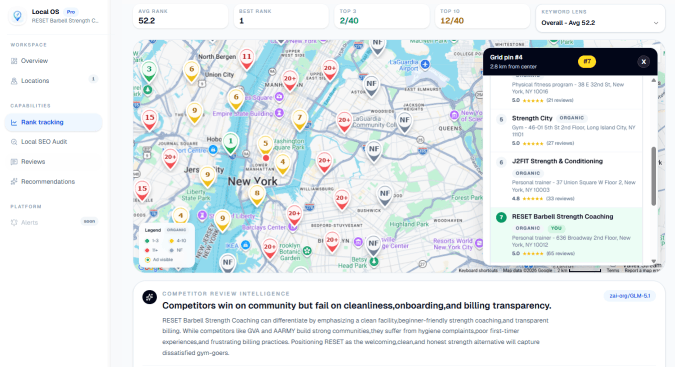
This is why local teams need better visibility before they choose tactics. Local OS reveals where a business is ranking, where competitors are winning, and which gaps deserve attention first.
You are leaving money on the table
Most local SEO advice still clusters around broad fundamentals and that creates two problems.
First, it encourages sameness.
If every business in a market has the same basic profile setup, similar categories, and a modest review count, those factors stop being differentiators.
Second, it overlooks how local ranking has become more behavioral and entity-driven.
Google does not merely index listings but it tries to infer which business is the most relevant, the most trusted, and the most likely to satisfy the user in a given micro-context.
That context includes:
- Users move from query to decision faster, especially on mobile.
- Google connects your profile, website, reviews, mentions, and brand signals.
- More businesses are investing in GBP Ranking and Local SEO.
- Weak, stale, or inconsistent signals can limit visibility even when basics are covered.
The result is that SEO and GEO Ranking for local businesses is becoming less about isolated optimizations and more about signal coherence.
When Google sees consistency across your profile, website, reviews, service areas, local mentions, and user actions, it has more confidence in your eligibility to rank prominently.
What the evidence generally establishes
Even without relying on any single unsourced claim, there are a few durable principles worth grounding this discussion in.
What remains reliably true in local search
Those points are well aligned with long-running local search patterns but the weighting and interaction of those signals are changing.
So rather than asking, “What is the one trick for Google Maps Ranking?” a better question is: Which underused signal combinations are likely to matter more in 2026?
Here are 5 new ways to rank your business in Google Maps in 2026.
1. Build “service proof” pages together with location pages
For years, local SEO teams created city pages at scale and some worked, but many were thin, repetitive, or obviously templated.
In a more competitive environment, that approach is less likely to produce durable Business Ranking gains on its own.
The stronger move in 2026 is to create service proof pages: pages that do not merely mention a city, but demonstrate why your business is meaningfully relevant to that service in that market.
A generic location page says:
- “We offer plumbing in Austin.”
A service proof page says:
- what specific plumbing issues are common in Austin neighborhoods
- what emergency response areas you actually cover
- what projects you completed nearby
- what the expected process looks like
- what permits, timelines, or local conditions affect the job
- which team members or specialists handle it
- what customer outcomes looked like
The practical challenge is prioritization.
Most businesses do not need more strategically placed pages. Rank maps and competitor evidence in Local OS can show which service-area combinations are underperforming and which competitors are capturing that demand.
Google can only rank what it can understand and if your website provides detailed, locally relevant evidence tied to real services, it becomes easier for Google to connect your site to your GBP and infer stronger relevance.
Client insightSEO optimized pages, stronger offers, and more focused work across every location.
What a strong service proof page includes
A practical structure for service proof pages
- 1
Lead with the service and area:
Clearly state what you do and where you do it, without keyword stuffing.
- 2
Add real local specificity:
Mention neighborhoods, service conditions, local regulations, common customer needs, or response logistics that actually affect the service.
- 3
Show evidence:
Include examples, outcomes, testimonials, FAQs, and details that demonstrate first-hand experience.
- 4
Connect to conversion:
Make it easy for users to call, book, request directions, or contact the nearest office.
- 5
Support with internal linking:
Link the page to the corresponding GBP landing page, related service pages, and contact or booking pages.
2. Treating reviews as topical relevance signals
Most businesses still think about reviews primarily in volume terms: get more five-star ratings and rankings should improve butthat thinking is incomplete if not harmful.
In 2026, the more strategic view is that reviews may function as topic-rich local validation.
Reviews can reinforce what you do, where you do it, how you do it, and whether customers trust the experience enough to describe it in their own words.
That does not mean businesses should script reviews or manipulate language but you should design your customer experience and review requests in ways that naturally elicit descriptive, useful feedback.
A vague review:
- “Great service!”
A stronger review signal:
- “They repaired our tankless water heater in North Phoenix the same day and explained the error code issue clearly.”
The second review may do more than improve conversion.
It reinforces local service relevance, especially when it aligns with your profile categories, website content, and actual services.
This same logic applies to competitor reviews. When customers repeatedly praise a competitor for speed, clarity, pricing, emergency response, or neighborhood coverage, that is market intelligence.
Client insightCompetitor intelligence gave me a much sharper read on the local market…
When they complain about missed appointments, poor communication, or vague pricing, those are positioning gaps your business can address.
This is exactly what Local OS surface for your business or clients.
A better review strategy
How to improve review quality without crossing ethical lines
Local OS surfaces what customers naturally mention for you to improve the service experience and messaging around those real patterns.
3. Optimize for “conversion confidence” inside the Google Business Profile
A lot of local SEO work still focuses on getting the impression but ranking without action is a fragile win.
If users click, hesitate, compare, and bounce back to the map results, that may limit the full value of your visibility.
That is why a more useful 2026 framework is conversion confidence optimization: reducing uncertainty inside your Google Business Profile so that searchers feel ready to choose you immediately.
You have to answer unspoken questions at the moment of decision:
- Are you actually open?
- Do you serve my area?
- Do you provide my specific service?
- Are you credible?
- Will contacting you be easy?
- Do I trust what happens next?
Businesses that rank in Google Maps increasingly need to remove friction directly in the listing experience.
What conversion confidence looks like in practice
A strong profile typically makes these signals easy to interpret:
- Outdated hours
- Few recent photos
- Generic business description
- Unclear service list
- Little evidence of activity
- Slow or inconsistent review responses
- Accurate hours and business details
- Recent, relevant photos of work, team, and location
- Clear service and category alignment
- Updated Q&A and profile content where applicable
- Consistent evidence of business activity
- Strong reviews with useful owner responses
This is where a Local OS SEO audit becomes useful. Instead of guessing whether the problem is photos, services, categories, website alignment, or review quality, an audit can surface the profile and website signals most likely to weaken confidence.
Why this is important for Google Maps Ranking
Even if Google does not disclose every interaction metric in local rankings, it is reasonable to infer that listings that consistently satisfy users create stronger aggregate performance signals than listings that create confusion.
This is where GBP Ranking and Business Ranking connect with operations and ranking strength is not just an SEO issue. It is often an experience design issue.
Actions to prioritize
A monthly conversion confidence routine
- 1
Audit core business details:
Verify hours, phone numbers, website URLs, service areas, and categories.
- 2
Refresh visual proof:
Add photos that reflect current work, staff, equipment, and premises.
- 3
Improve service clarity:
Make sure services, descriptions, and supporting site pages align.
- 4
Review user friction:
Check for unanswered questions, inconsistent information, or conversion dead ends.
- 5
Measure action quality:
Track calls, direction requests, form fills, and lead quality where possible.
For agencies, this is a strong place to add value because it connects ranking work to revenue outcomes. For owners, it is one of the most controllable ways to improve Local SEO performance.
4. Use local brand mentions to strengthen entity trust
Traditional citation building is no longer enough to think only in terms of directory consistency.
More mature signal is likely to come from brand mention quality across the local web.
That includes mentions from:
- local news or community sites
- niche industry directories
- chambers of commerce
- neighborhood organizations
- event sponsorship pages
- local partnerships
- vendor or association pages
- credible listicles or local recommendation roundups
The key difference is that these mentions do more than confirm name, address, and phone number.
They help Google understand your business as a real local entity with contextual legitimacy.
However, be cautious with directory listing services. Submitting the profile you’ve carefully built to hundreds of directories can do far more harm than good for your business or your clients in the medium and long term.
Here's a much smarter local mention strategy
What to pursue beyond citations
5. Align your first-party data with search intent patterns
One of the most underused ranking advantages in local search is first-party insight.
Businesses often have a rich stream of customer data—calls, intake forms, booking reasons, service requests, chat transcripts, appointment types, and recurring questions but fail to convert that information into SEO and GBP improvements.
You should use first-party data to identify the exact language customers use when they are ready to buy locally.
Many local businesses optimize for industry jargon while customers search with problem-based language, urgency modifiers, and neighborhood context.
For example, customers may not search:
- “residential drainage correction contractor”
They may search:
- “yard flooding fix near me”
- “drainage company for standing water”
- “French drain installer in West Houston”
If your website, FAQ content, service pages, and Google Business Profile do not reflect those patterns, you risk weak relevance matching even when you offer the right service.
The next edge in SEO Ranking is better translation between what customers ask for, what your team delivers, and how Google interprets that connection.
How to operationalize first-party local intent
Turning customer demand into ranking signals
- 1
Collect real customer language:
Review intake forms, call notes, sales emails, chat logs, and support questions.
- 2
Cluster by service intent:
Group terms by problem, urgency, geography, and service outcome.
- 3
Map clusters to pages and profile elements:
Update service pages, FAQs, GBP services, and supporting content accordingly.
- 4
Validate against conversions:
Prioritize language that leads to booked jobs or qualified leads, not just impressions.
- 5
Refresh quarterly:
Search behavior changes as market conditions, seasons, and service demand shift.
Local ranking is a systems problem
Local search performance now behaves more like a system.
A business tends to perform better when these layers reinforce each other:
Your GBP needs to be complete, current, and aligned with reality.
Your site must prove what you do and where you do it.
Customer language helps validate service quality and topical relevance.
Off-site recognition reinforces prominence and legitimacy.
Users need enough trust to act without excessive comparison.
Seen this way, Local SEO is part operations, part messaging, part customer experience, and part reputation architecture.
That is good news for serious businesses because it means rankings are less likely to be won by shortcuts alone.
Practical next steps for business owners and agencies
If you want to act on these ideas without turning them into an unfocused project, prioritize in this order:
90-day execution priorities
For agencies, this can become a more defensible service model. Instead of selling generic local SEO retainers, you can sell:
- local authority building
- service proof content
- GBP conversion optimization
- review intelligence systems
- local entity mention campaigns
For business owners, the advantage is equally clear: these efforts are harder to commoditize than checklist SEO.
How to operationalize this inside Local Visibility OS
Use the Locations workflow to keep business data and map anchors clean, then run Rank Tracking to measure visibility across the neighborhoods that actually matter. From there, your team can turn grid gaps, competitor movement, and review patterns into weekly next actions instead of vague SEO to-dos.
Related local visibility guides
These articles reinforce the same workflow from different angles, so readers can move from one topic into a fuller local growth system.
Thought Leadership Article
Google Business Profile Ranking in Google Maps Factors 2026
The Google Business Profile ranking factors that matter most in Maps in 2026, with a practical operator lens.
Thought Leadership Article
The NEW Way To Rank #1 on Google Maps in 2026 (FAST)
A faster 2026 playbook for improving Google Maps rankings by building a clearer, evidence-rich local entity.
Thought Leadership Article
How A Small Business Can Rank Higher on Google Maps Without Ads
How small businesses can rank higher on Google Maps without ads by tightening trust, reviews, and local relevance.