
How competitor reviews explain local ranking gaps
Use competitor review patterns to understand customer expectations, positioning gaps, and the next actions that can improve local visibility.
Rankings tell you what is happening. Reviews often explain why it matters.
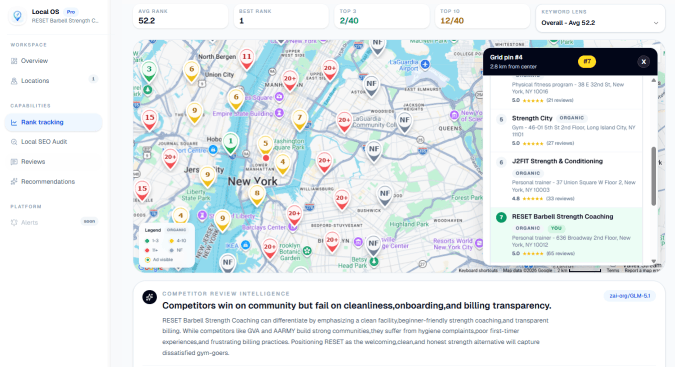
When competitors outrank a business in Google Maps, the answer is rarely one signal. It can involve proximity, categories, review volume, review velocity, profile completeness, website signals, and local relevance.
Competitor review intelligence helps operators move from speculation to evidence.
Customers praise
Speed, trust, clarity, convenience
Competitors expose
Weak service moments and positioning gaps
Operators act
Copy, profile updates, service fixes, review prompts
Reviews reveal customer priorities
Customers write about what they remember. That can be speed, cleanliness, pricing, friendliness, availability, expertise, parking, response time, or trust.
If several competitors win praise for the same theme, that theme may represent a market expectation. If they repeatedly receive complaints about the same issue, that issue may become a positioning opportunity.
For example:
- A clinic may win because patients mention calm onboarding and transparent pricing.
- A gym may lose trust because reviews mention crowded classes and unclear cancellation rules.
- A home service provider may stand out because reviews mention fast arrival and tidy work.
These patterns are useful because they connect search visibility to real buying language.
The goal is not to copy competitors
Review analysis should not become imitation. The point is to understand the local market more clearly.
Useful questions include:
- What do customers praise in the businesses above us?
- What do customers complain about repeatedly?
- Which phrases show up in satisfied reviews?
- Which trust signals are missing from our own profile or website?
- Which promises can we make honestly and support operationally?
That last word matters: honestly. Good local SEO should amplify real strengths, not invent them.
Why evidence matters for AI recommendations
Generic AI advice is cheap. Grounded advice is useful.
When recommendations are based on actual review snippets, competitor patterns, rank scan results, and audit checks, the output becomes easier to trust. Operators can see the evidence behind a suggested action and decide whether it fits the business.
Evidence example
From generic advice to specific action
Generic recommendation: get more reviews.
Evidence-led recommendation: ask recent happy customers to mention appointment availability and first-visit clarity, because competitors are winning praise for quick booking while your profile lacks that theme.
That is the difference between "get more reviews" and "ask recent customers to mention appointment availability, because nearby competitors are winning praise for quick booking and your profile does not show that theme yet."
Turning reviews into action
Competitor review intelligence can support several workflows:
- GBP updates that reflect real customer priorities.
- Website copy tests based on proven local demand language.
- Review request prompts that encourage specific, policy-safe feedback.
- Service improvements that address recurring complaints in the market.
- Client reporting that explains why a recommendation matters.
The takeaway
Reviews are one of the richest public data sources in local SEO. Used well, they help teams understand what customers value, where competitors are vulnerable, and which actions deserve attention first.
The best recommendations do not come from guessing. They come from evidence.